Outage Ready: a 24-hour outage
One full day without power: what it takes to keep the fridge, internet and lights going, and where solar helps.
Published · Updated
Our example essentials need about 2,330 Wh a day, or roughly 3,200 Wh of rated battery. That's a 1kWh-class station plus an expansion battery, or an expanded station plus about 400W of solar on a sunny day.
- About 2,330 Wh usable for one day.
- Around 3.2kWh of rated battery, or less with solar.
- Expandable stations make the jump easiest.
What a typical home keeps running
Our example essentials list. Swap in your own devices in the Power Planner.
| Device | Example draw | Wh/day |
|---|---|---|
| Refrigerator (EnergyGuide 550 kWh/yr example) | ≈63 W average | 1,507 |
| Wi-Fi router + modem | 15 W | 360 |
| LED lights, 4 × 10 W for 5 h | 40 W | 200 |
| Phones (2), charging | 10 W for 2 h | 20 |
| Laptop | 60 W for 4 h | 240 |
| Total | 2,327 |
Battery size for 24 hours
Energy needed: 2,327 Wh/day × 24 h ÷ 24 ≈ 2,327 Wh usable. Divide by 0.736 (our estimate: 80% usable depth from Victron LiFePO4 data × 92% inverter efficiency from the NREL PVWatts manual; an estimate for power stations) to get about 3,162 Wh of rated capacity with no recharging.
A single 1kWh-class station covers well under half. Options: add an expansion battery (Anker C1000 to 2,112Wh, DELTA 3 up to 5kWh), or add solar.
| Option | Rated Wh | Covers the plan? |
|---|---|---|
| One 1kWh-class station | 1,024–1,152 | No, roughly 8–9 hours of everything |
| C1000 + expansion battery | 2,112 | Most of a day |
| DELTA 3 + extra battery | Up to 5,000 | Yes |
Solar or a generator?
As an example, 400W of panels in a place with 4 peak sun hours, with the PVWatts V1 total derate of 0.77 (NREL PVWatts manual), makes about 1,232 Wh a day. That's an estimate; check your location with NREL PVWatts. See peak sun hours and generator vs battery backup.
That roughly fills the gap between a 2kWh battery and a full day, if the sun cooperates.
Food and safety checklist
- FoodSafety.gov: an unopened fridge keeps food safe for about 4 hours; a full freezer about 48 hours (24 if half full).
- Keep a flashlight and a battery radio that don't depend on the power station.
- Run any generator outdoors, far from doors and windows. The CDC warns that generator exhaust can kill.
- Never connect anything to home wiring without a transfer switch or interlock fitted by a licensed electrician.
Picks for this plan
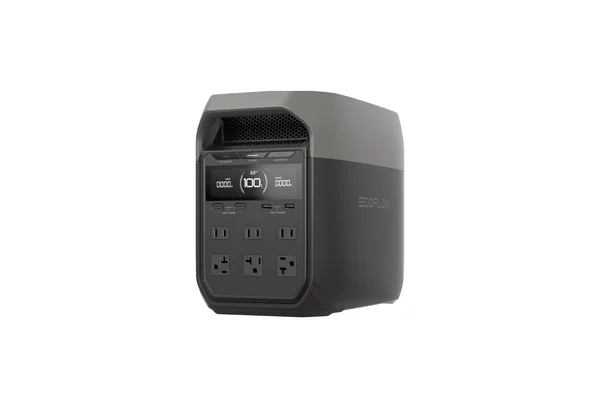
EcoFlow DELTA 3 (1,024Wh)
Expandable up to 5kWh; 500W solar input.
Check price on Amazon (opens in a new tab)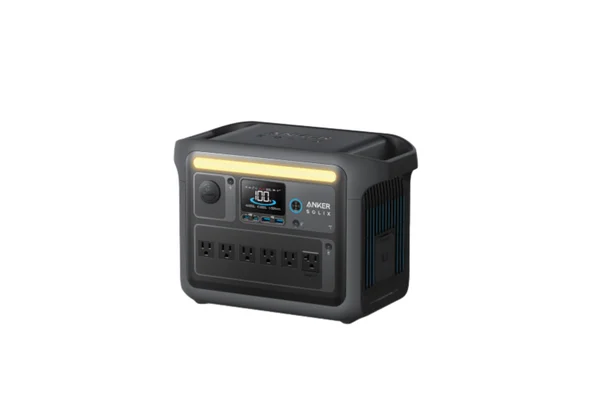
Anker SOLIX C1000 (1,056Wh)
Expandable to 2,112Wh; 600W solar input.
Check price on Amazon (opens in a new tab)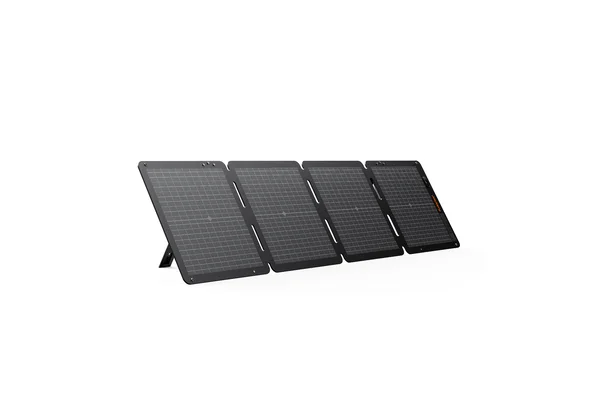
Jackery SolarSaga 100W Air folding panel
A folding panel for recharging a station on the porch.
Check price on Amazon (opens in a new tab)FAQ
Can solar alone get me through a day?
Not overnight; solar needs a battery to store daytime energy. Pair panels with enough battery for the night.
Where do I go next?
Try the power planner to put numbers to your own situation, or see the product picks on the deals page.
Terms used here
- Watt (W)
- Rate of power use or production.
- Watt-hour (Wh)
- Energy: one watt for one hour.
- Kilowatt-hour (kWh)
- 1,000 watt-hours.
- Depth of discharge (DoD)
- Share of a battery's capacity that is used.
- LiFePO4 (LFP)
- Lithium iron phosphate battery chemistry.
- Inverter
- Converts DC battery power to AC household power.
- Peak sun hours
- Hours of equivalent 1,000 W/m² sunlight per day.
- Derate
- Factor for real-world losses in solar output.
- Transfer switch
- Device that isolates home circuits from the grid during backup.
Sources
This guide is informational and based on published specifications and general references, not hands-on testing. Check the manufacturer's current specs before you buy.