Outage Ready: a 3-day outage
Three days without power is where battery-only plans get expensive. Here's a mixed battery, solar and generator plan.
Published · Updated
Three days of our example essentials is about 7,000 Wh, or around 9,500 Wh of rated battery with no recharge. A practical plan is a 2–5kWh battery, 500W of solar, and a small generator for cloudy stretches.
- About 7,000 Wh usable over 72 hours.
- Battery-only is possible but large.
- Mix battery, solar and a generator.
What a typical home keeps running
Our example essentials list. Swap in your own devices in the Power Planner.
| Device | Example draw | Wh/day |
|---|---|---|
| Refrigerator (EnergyGuide 550 kWh/yr example) | ≈63 W average | 1,507 |
| Wi-Fi router + modem | 15 W | 360 |
| LED lights, 4 × 10 W for 5 h | 40 W | 200 |
| Phones (2), charging | 10 W for 2 h | 20 |
| Laptop | 60 W for 4 h | 240 |
| Total | 2,327 |
Battery size for 3 days
Energy needed: 2,327 Wh/day × 72 h ÷ 24 ≈ 6,981 Wh usable. Divide by 0.736 (our estimate: 80% usable depth from Victron LiFePO4 data × 92% inverter efficiency from the NREL PVWatts manual; an estimate for power stations) to get about 9,485 Wh of rated capacity with no recharging.
Battery-only at this size means a home battery or a fully expanded portable system. Most people combine sources.
| Option | Rated Wh | Covers the plan? |
|---|---|---|
| DELTA 3 fully expanded | Up to 5,000 | Not alone |
| 2–5kWh battery + 500W solar + generator | 2,000–5,000 | Yes |
Solar or a generator?
As an example, 500W of panels in a place with 4 peak sun hours, with the PVWatts V1 total derate of 0.77 (NREL PVWatts manual), makes about 1,540 Wh a day. That's an estimate; check your location with NREL PVWatts. See peak sun hours and generator vs battery backup.
Run a generator a few hours a day to recharge the battery rather than all night. Keep it outdoors, far from windows, and store fuel safely.
Food and safety checklist
- FoodSafety.gov: an unopened fridge keeps food safe for about 4 hours; a full freezer about 48 hours (24 if half full).
- Keep a flashlight and a battery radio that don't depend on the power station.
- Run any generator outdoors, far from doors and windows. The CDC warns that generator exhaust can kill.
- Never connect anything to home wiring without a transfer switch or interlock fitted by a licensed electrician.
Picks for this plan
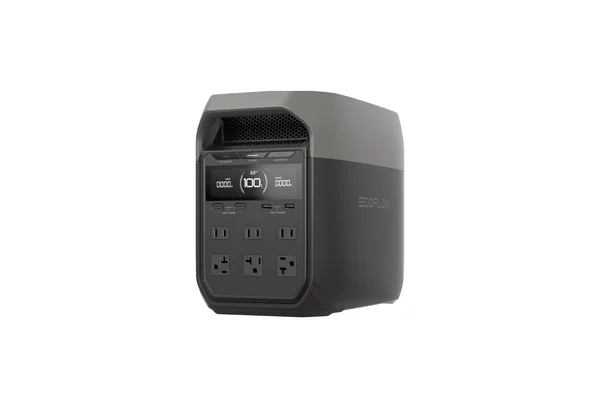
EcoFlow DELTA 3 (1,024Wh)
Expandable up to 5kWh; accepts AC charging from a generator.
Check price on Amazon (opens in a new tab)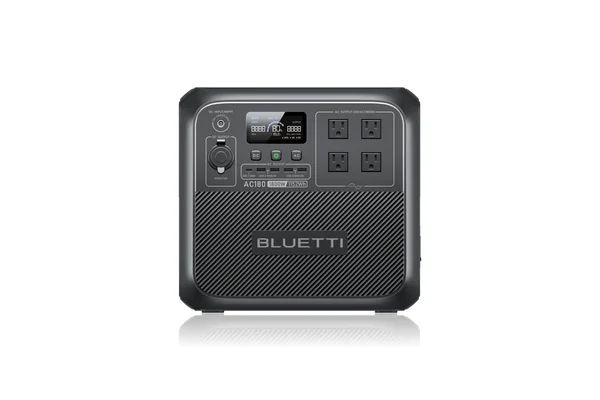
BLUETTI AC180 (1,152Wh)
1,440W Turbo AC input recharges quickly from a generator.
Check price on Amazon (opens in a new tab)FAQ
How much generator do I need to recharge a station?
Enough to cover the station's AC charging input, for example 1,440W for the AC180 in Turbo mode, plus anything else running at the same time. Check the station's manual.
Where do I go next?
Try the power planner to put numbers to your own situation, or see the product picks on the deals page.
Terms used here
- Watt (W)
- Rate of power use or production.
- Watt-hour (Wh)
- Energy: one watt for one hour.
- Kilowatt-hour (kWh)
- 1,000 watt-hours.
- Depth of discharge (DoD)
- Share of a battery's capacity that is used.
- LiFePO4 (LFP)
- Lithium iron phosphate battery chemistry.
- Inverter
- Converts DC battery power to AC household power.
- Peak sun hours
- Hours of equivalent 1,000 W/m² sunlight per day.
- Derate
- Factor for real-world losses in solar output.
- Transfer switch
- Device that isolates home circuits from the grid during backup.
Sources
This guide is informational and based on published specifications and general references, not hands-on testing. Check the manufacturer's current specs before you buy.