Buying guide
Portable power stations: what the specs mean
Capacity, output, solar input and recharge time decoded.
Published · Updated
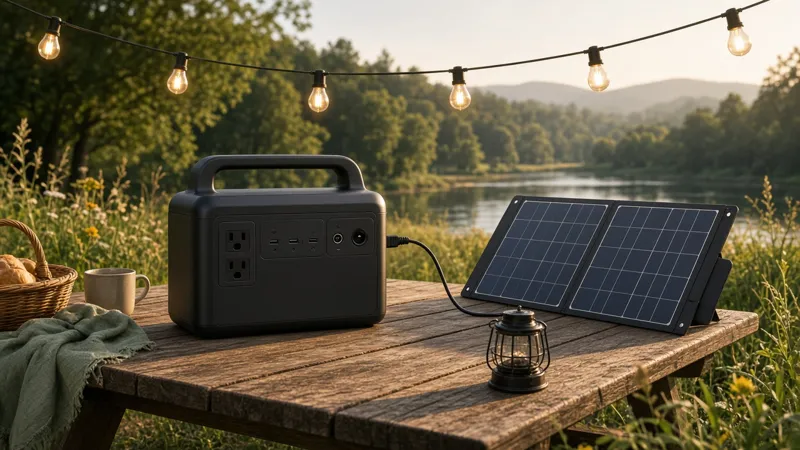
A portable power station is a battery, an inverter, a charger and outlets in one box. Choose by capacity in watt-hours for how long it runs, continuous inverter watts for what it can run, and surge watts for motor start-up. Then look at chemistry (LiFePO4 for cycle life, NMC for lighter weight), recharge options (wall, solar input watts and voltage range, car), and the outlet mix. Rough usable runtime is Wh × 0.80 × 0.92 (about 0.74) ÷ load watts. Size from a load list and use the power planner.
- Capacity (Wh) sets runtime; AC output (W) sets what it can power.
- Solar input watts and voltage limits decide how fast panels refill it.
- UPS or pass-through modes vary; check switchover time if you need it.
Key specs explained
| Spec | What it means | Why it matters |
|---|---|---|
| Capacity (Wh) | Stored energy | How long it runs |
| Continuous output (W) | Steady inverter power | What it can run |
| Surge / peak (W) | Short burst power | Starting motors |
| Chemistry | LiFePO4 or NMC | Cycle life, weight |
| Cycle rating | Cycles to a stated capacity (e.g., 80%) | Lifespan |
| AC charge input (W) | Wall charging speed | Recharge time |
| Solar input (W, V range) | Max panel power and voltage | Solar planning |
| Outlets | AC, USB-C PD watts, 12 V | Device compatibility |
| Weight | Portability | Carry or cart |
See watt-hours explained.
Estimating runtime
Runtime (hours) ≈ capacity (Wh) × 0.80 usable depth × 0.92 inverter efficiency ÷ load (W). 0.80 is from Victron LiFePO4 data and 0.92 is the inverter derate in the NREL PVWatts manual; applying either to a power station is an estimate, so use the maker's own figures when published. DC (USB, 12 V) outputs often lose less.
| Load (example) | Watts | 1,000 Wh station runtime (approx.) |
|---|---|---|
| Phone charging | 10 | Many full charges |
| Laptop | 60 | ~12 h |
| CPAP (no humidifier, varies) | 30–60 | ~12–25 h |
| Mini fridge (average) | 50 | ~15 h |
| Box fan | 50 | ~15 h |
| Microwave | 1,000+ input | Under 1 h of cooking, if the inverter can run it |
These are examples. Measure your devices or check their labels. For CPAP, follow the device maker's power guidance.
Chemistry: LiFePO4 vs NMC
| LiFePO4 (LFP) | NMC | |
|---|---|---|
| Cycle life | Often listed at 3,000+ cycles to 80% | Often hundreds to ~1,000+ |
| Weight per Wh | Heavier | Lighter |
| Thermal stability | Generally more stable | Good, but less margin |
| Common use | Most newer stations | Older and lighter stations |
Check each model's datasheet. See battery chemistry guide.
Recharging options
Wall
Many newer stations recharge from AC in one to a few hours. Fast charging may be louder and warmer.
Solar
Check the solar input watts and the voltage window. Panels in series must stay under the max voltage, including cold-weather voltage rise. See solar panel sizing and peak sun hours.
Car
12 V car charging is slow, often around 100 W or so. It's useful on road trips.
Expansion batteries
Some models accept add-on batteries. Check compatibility.
How to choose
- Make a load list with watts and hours. Use the power planner.
- Size Wh to your daily need ÷ 0.92 ÷ 0.80 (inverter and usable depth, as in the power fit tool), plus margin.
- Check continuous and surge watts against your biggest load. See inverter sizing and surge.
- Choose chemistry by how often you'll cycle it.
- Plan recharging: wall, solar or car.
- Check outlets and weight.
Worked scenarios
Scenario 1: camping weekend
Lights, phones, a fan and a small 12 V fridge come to about 600–900 Wh over two days. A ~1,000 Wh station plus a 100–200 W panel works.
Scenario 2: power-outage essentials
Router, phone, laptop and lamps total about 800 Wh/day. A 1,000–1,500 Wh station covers a day. Add solar for longer outages.
Scenario 3: fridge backup
A fridge at about 1,200 Wh/day plus surge needs a large station, roughly 2,000 Wh or more, with enough surge capacity, or a larger home backup system. See home backup battery basics.
Scenario 4: van life
Larger stations with high solar input and expansion batteries. Plan around daily solar harvest.
Common mistakes
- Ignoring surge. Motors trip undersized inverters.
- Expecting full Wh at the AC outlet.
- Exceeding solar input voltage.
- Storing at 100% or 0% for months. Follow the manual's storage charge guidance.
- Plugging into home wiring with a backfeed cord. This is dangerous and illegal in many places. Use a proper transfer switch installed by an electrician.
Safety notes
- Use and charge on stable, dry surfaces away from heat. Follow ventilation guidance.
- Never connect to home wiring without a code-compliant transfer device installed by a licensed electrician.
- Battery power stations don't produce carbon monoxide. Gas generators do, so keep generators outdoors, far from windows, as the CPSC advises.
- Check air travel rules on the FAA site. Most stations can't fly.
- See the deals page for station and panel picks.
FAQ
Can a power station run my refrigerator?
Often, if the inverter's continuous and surge ratings cover the fridge's running and start-up draw, and the capacity covers its daily Wh. Meter the fridge to know for sure.
Is it safe indoors?
Battery power stations don't produce exhaust, unlike gas generators, so they're commonly used indoors. Follow the manual for ventilation, charging and placement.
Can I take one on a plane?
Most power stations are far above airline lithium battery limits. The FAA generally limits spare lithium-ion batteries to 100 Wh without approval, and 101–160 Wh with airline approval.
What is pass-through charging?
Powering devices while the station itself charges. Many models support it. Some have a UPS-like mode with a stated switchover time, which isn't always as fast as a dedicated UPS.
Where do I go next?
Try the power planner to put numbers to your own situation, or see the product picks on the deals page.
Terms used here
- Watt (W)
- Rate of power use or production.
- Watt-hour (Wh)
- Energy: one watt for one hour.
- Cycle life
- Number of charge-discharge cycles a battery is rated for at a stated DoD.
- LiFePO4 (LFP)
- Lithium iron phosphate battery chemistry.
- NMC
- Nickel manganese cobalt lithium chemistry.
- Inverter
- Converts DC battery power to AC household power.
- Surge rating
- Short-term peak power an inverter can supply.
- Peak sun hours
- Hours of equivalent 1,000 W/m² sunlight per day.
- Derate
- Factor for real-world losses in solar output.
- Transfer switch
- Device that isolates home circuits from the grid during backup.
- Backfeed
- Power flowing into utility lines from a home source; dangerous.
- Pass-through charging
- Using a power station while it charges.
Sources
This guide is informational and based on published specifications and general references, not hands-on testing. Check the manufacturer's current specs before you buy.